
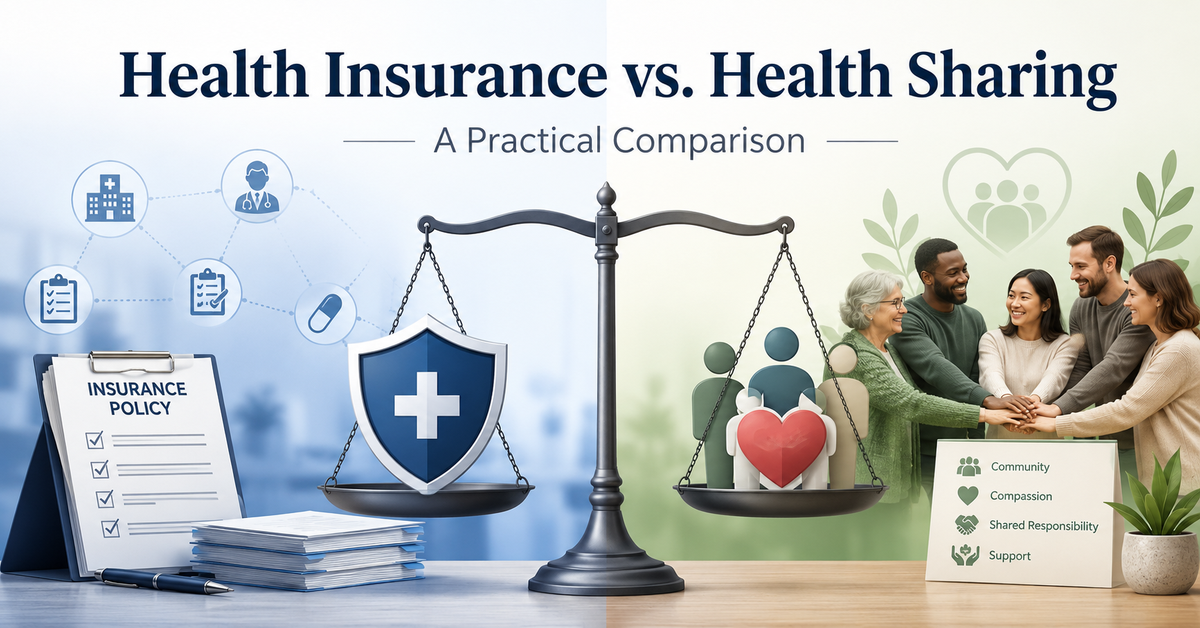
People searching for ways to manage medical expenses have several options. Along with employer-sponsored plans, individual insurance policies, and public programs, some consumers are evaluating healthcare sharing arrangements.
These arrangements include traditional healthcare sharing ministries and newer community-based organizations that facilitate medical cost sharing without necessarily holding the same legal classification.
Although health insurance and healthcare sharing can both help households manage large medical bills, they differ significantly in legal protections, financial obligations, provider access, and eligibility rules.
How Traditional Health Insurance Works
Health insurance is a regulated financial product based on a contract between a policyholder and an insurer.
The policyholder pays a premium. In exchange, the insurer agrees to cover specified medical services according to the policy’s terms. Costs may be divided among deductibles, copayments, coinsurance, and an out-of-pocket maximum.
The federal government defines insurance cost sharing as the portion of covered expenses paid by the policyholder. A more detailed definition is available in the HealthCare.gov cost-sharing glossary.
Health insurance also comes with legal and regulatory protections. When a service is covered and the policyholder satisfies the relevant conditions, the insurer is contractually obligated to process the claim.
The tradeoff is that insurance can be costly. Plans may also use restricted provider networks, prior-authorization rules, referrals, and higher charges for out-of-network treatment.
How Healthcare Sharing Works
Healthcare sharing follows a different model.
Members contribute a recurring amount to a community. Those contributions may be used to help with other members’ eligible medical expenses.
The arrangement is voluntary and governed by membership guidelines rather than an insurance contract. Members generally accept a defined amount of personal financial responsibility before additional expenses become eligible for sharing.
The organization reviews submitted bills and determines whether the medical need satisfies its guidelines. Because the arrangement is not insurance, approval and payment are not guaranteed under the same laws that apply to regulated insurance policies.
The National Association of Insurance Commissioners’ consumer guidance recommends that consumers understand exactly which benefits they can count on before enrolling in a sharing program.
Traditional Ministries and Newer Communities
Traditional healthcare sharing ministries are typically organized around shared religious or ethical beliefs. Some require detailed faith statements or lifestyle commitments.
The federal definition of a healthcare sharing ministry also includes organizational and historical criteria. As a result, a newer organization may operate a similar medical cost-sharing system without qualifying for the formal ministry designation.
Newer sharing communities may use broader ethical standards and allow participation from people with a wider range of beliefs. Nevertheless, they remain distinct from insurance unless they are licensed and regulated as insurance products.
A nonprofit designation does not change that distinction. The IRS requirements for 501(c)(3) organizations focus on tax-exempt purposes and organizational conduct, not on whether an organization provides insurance guarantees.
Comparing Monthly and Annual Costs
Healthcare sharing programs may have lower monthly contribution amounts than some individual insurance policies. This can be appealing to people who do not receive employer assistance or qualify for significant Marketplace subsidies.
However, monthly cost is only one part of the comparison.
An insurance plan may include preventive services, office visits, prescriptions, and a defined annual out-of-pocket limit. A sharing arrangement may require members to pay routine medical costs themselves or exclude certain categories of treatment.
Consumers should estimate total annual spending under each option. That calculation should include monthly payments, routine care, prescriptions, the member’s initial responsibility, and expenses that are not eligible for sharing.
Comparing Provider Choice
Insurance plans commonly use networks of contracted doctors, hospitals, laboratories, and pharmacies. Using an out-of-network provider can increase the patient’s responsibility or result in no coverage.
Many healthcare sharing programs do not use traditional networks. Members may visit any licensed provider willing to treat them as self-pay patients.
This can provide greater freedom, but it may also require more active involvement. Members might need to request cash-pay prices, negotiate discounts, obtain itemized bills, and communicate directly with provider billing departments.
Provider freedom should therefore be evaluated alongside the administrative work expected from the member.
Comparing Medical History Rules
Regulated major medical insurance generally cannot deny enrollment because of a person’s medical history. Healthcare sharing programs may use different rules.
Some restrict expenses related to conditions that existed before membership. Others apply waiting periods, gradually increasing sharing levels, or permanent limitations.
People with chronic conditions, ongoing prescriptions, or planned procedures should review these provisions especially carefully.
Consumers can compare available regulated plans through the official Health Insurance Marketplace before deciding whether a sharing arrangement provides an appropriate alternative.
Choosing the Right Model
Insurance offers contractual protections and regulatory oversight but may involve higher premiums and limited networks. Healthcare sharing may provide lower monthly costs and broader provider flexibility, but it places more responsibility and risk on the member.
Neither model is automatically right for everyone.
The strongest decision comes from reading the complete documents, calculating realistic annual costs, examining exclusions, and considering both current healthcare needs and unexpected emergencies. Price matters, but it should be weighed alongside legal protections, eligibility rules, provider access, and financial risk.